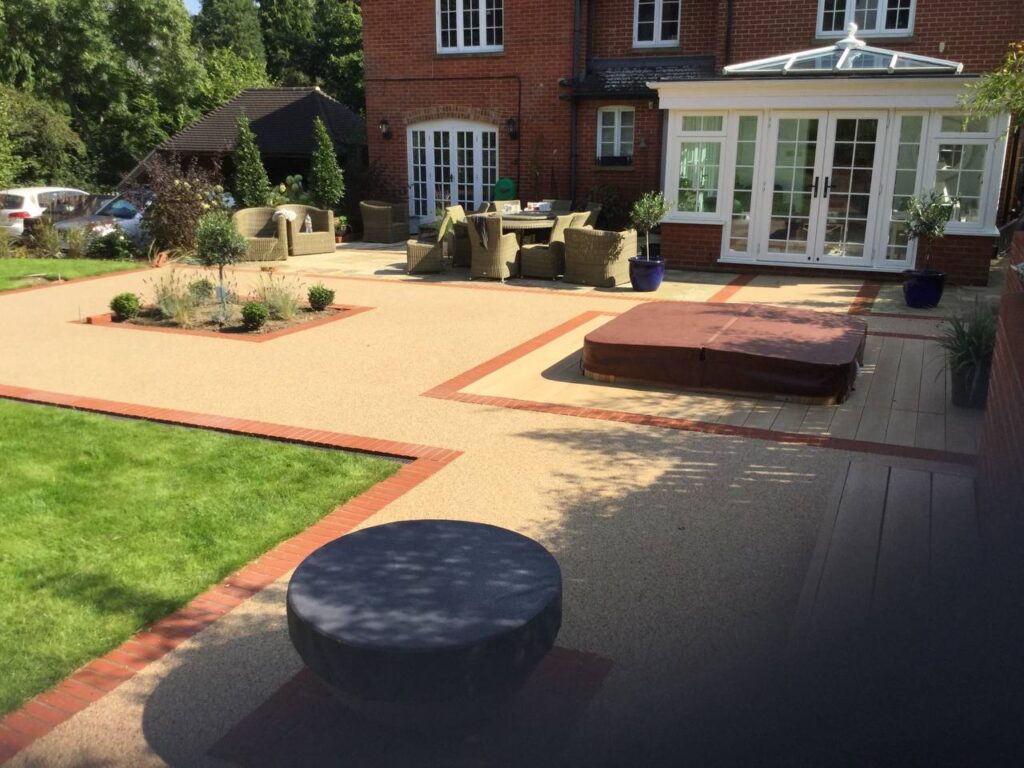
A resin bound driveway can provide an attractive, practical surface for regular vehicle use when it is designed and installed correctly. The finished surface is created by thoroughly mixing selected aggregate with resin before the material is laid and finished as a continuous layer.
For homeowners in Sheffield, South Yorkshire, the suitability of resin bound surfacing depends on much more than appearance. A driveway must cope with repeated parking, turning and vehicle movement, which means the supporting base, surface thickness, drainage, edging and installation quality all play an important part.
When these elements are properly considered, resin bound surfacing can create a stable, smooth and visually consistent driveway that works well for day-to-day use.
Why Can Resin Bound Surfacing Work Well for Driveways?
A driveway is subjected to regular loading in the same locations.
Vehicles often follow the same route onto the property, turn in similar areas and remain parked in the same spaces.
For a resin bound surface to perform effectively, the entire construction needs to support these repeated movements.
The Strength Starts Below the Resin Surface
The visible resin bound layer is only one part of the driveway.
The supporting construction beneath it plays a major role in how well the driveway performs.
If the base is unstable, poorly compacted or already moving, the finished surface can eventually reflect those problems.
Professional installation therefore begins by assessing what lies underneath.
A Stable Base Is Essential for Vehicle Use
Cars place considerably more load on a surface than pedestrians.
This loading is concentrated beneath the tyres and repeated every time the driveway is used.
A stable base helps spread these loads and prevents excessive movement beneath the resin bound layer.
Without suitable support, even a high-quality surface can become vulnerable to cracking or localised settlement.
Existing Bases Should Be Assessed Properly
Resin bound surfacing can sometimes be installed over an existing suitable base.
However, the existing surface should not automatically be assumed to be sound.
Cracking, movement, settlement and drainage problems need to be investigated first.
Covering an unstable base does not remove the underlying cause of the problem.
Resin Bound Surfacing Cannot Correct a Failing Foundation
A new surface may improve the appearance of a driveway, but it cannot permanently compensate for movement below.
If an existing area has sunk because the base is weak, applying resin bound material directly over it is unlikely to provide a satisfactory long-term solution.
The cause of the movement should be corrected first.
This is one of the most important parts of professional driveway preparation.
Correct Compaction Helps Support the Driveway
Where a new base is being constructed, each layer needs appropriate compaction.
Loose or inconsistently compacted material can settle after vehicles begin using the driveway.
This can create depressions or uneven sections.
Proper preparation creates a more uniform foundation before the surface is installed.
Everyday Parking Creates Concentrated Loads
A vehicle may remain in the same position for many hours.
This creates repeated loading in predictable areas.
The driveway therefore needs to be constructed for more than occasional vehicle movement.
Parking spaces, turning areas and entrance routes should all be considered when planning the base and surface.
Turning Areas Need Particular Attention
Vehicle tyres create different forces when turning than when travelling in a straight line.
This is especially relevant where cars repeatedly turn tightly to enter garages or manoeuvre into parking positions.
The surface and base need to cope with these movements.
A properly installed resin bound driveway can provide a stable continuous surface when the supporting construction is suitable.
The Entrance Often Receives the Most Traffic
Nearly every vehicle passes over the driveway entrance.
This means the same section can experience significantly more loading than quieter areas.
The transition between the driveway and adjoining surface should therefore be properly prepared and supported.
Weakness at the entrance can affect the usability and appearance of the whole driveway.
Resin Bound Surfacing Creates a Continuous Finish
One of the practical characteristics of resin bound surfacing is its continuous appearance.
The aggregate is mixed with resin before installation, creating a bonded surface rather than a collection of loose stones.
This helps produce a neat and consistent finish across parking and turning areas.
It also means aggregate is less likely to migrate under vehicle movement than with loose gravel surfaces.
Resin Bound Should Not Be Confused With Resin Bonded Surfacing
The two systems are different.
With resin bound surfacing, aggregate and resin are mixed together before being laid.
With resin bonded surfacing, aggregate is generally applied onto a resin layer.
Understanding this distinction is important because the construction and finished characteristics are not the same.
For driveway applications, the appropriate system should be selected according to the intended use.
The Aggregate Is Held Within the Resin Matrix
Because the stones are mixed with resin before installation, the finished surface forms a bonded matrix.
This contributes to the smooth and consistent feel of the driveway.
The aggregates remain visible, giving the surface its textured decorative appearance, while being held together rather than left loose.
Correct mixing is critical to achieving this result.
Consistent Mixing Matters
The correct proportion and distribution of resin throughout the aggregate are important.
Poor mixing can result in inconsistent areas within the surface.
Professional installation aims to ensure that the aggregate is evenly coated before the material is placed.
This helps create a uniform finish across the driveway.
Installation Conditions Matter
Resin bound surfacing needs to be installed under suitable conditions.
Temperature, moisture and working time can all influence how the material behaves during installation.
Professional installers plan the work accordingly so that mixing, laying and finishing can be completed consistently.
The quality of the finished driveway depends on controlling the complete installation process.
Surface Thickness Needs to Suit the Application
A driveway surface needs to be appropriate for vehicle use.
The required construction can vary according to the base, aggregate and intended loading.
A pedestrian path and a regularly used driveway should not automatically be treated identically.
Professional installation should consider how the surface will actually be used.
Resin Bound Driveways Provide a Smooth Surface
A properly installed resin bound driveway can create a relatively smooth and consistent finish.
This makes vehicle movement straightforward and can also improve pedestrian usability around parked cars.
The aggregate still provides texture, so the finished appearance is not completely flat or polished.
The objective is an even, well-finished surface.
An Even Surface Makes Parking Easier
Deep ruts, loose material and uneven sections can make parking less convenient.
A well-constructed resin bound driveway provides a more consistent area for positioning and manoeuvring vehicles.
This can be especially useful where several cars need to use the available space efficiently.
Accurate preparation helps ensure the finished levels remain practical.
Good Levels Are Essential
A driveway should not simply be completely level.
The surface needs appropriate falls to help control rainwater.
These levels must be planned before installation.
Incorrect falls can create low spots where water collects or direct water towards areas where it is not wanted.
Drainage Should Be Considered as Part of the Whole Construction
Resin bound surfacing is often associated with permeability.
However, drainage performance depends on more than the visible resin layer.
The complete construction beneath the surface needs to support the intended drainage approach.
A permeable surface installed over an unsuitable impermeable or poorly designed base will not automatically solve water management issues.
Permeability Depends on the Full System
The spaces between the bound aggregate can allow water to pass through the resin bound layer when the system is designed for permeability.
What happens next depends on the layers underneath.
The base and sub-base need to accommodate the movement of water appropriately.
This is why drainage should be designed as part of the driveway construction rather than assumed from the surface material alone.
Existing Drainage Problems Should Be Addressed Before Installation
If an existing driveway already experiences persistent ponding, the reason should be investigated.
Low spots, settlement or unsuitable falls can all contribute.
Installing a new resin bound layer without correcting these problems may simply reproduce them in the finished driveway.
Professional preparation should deal with the cause first.
Standing Water Can Reveal Problems With Levels
Water collecting in one place repeatedly can indicate that the driveway is not draining as intended.
A small temporary wet area following rainfall is different from persistent ponding.
If water consistently remains in the same depression, the levels or supporting construction may need attention.
Accurate preparation reduces the likelihood of these problems.
Edging Helps Contain the Surface
The perimeter of a resin bound driveway needs careful detailing.
Suitable edge restraints help define the shape of the driveway and support the surface at its boundaries.
This is particularly important where resin meets lawns, planting beds, paths or other materials.
Good edging contributes both to the appearance and practical performance of the installation.
Strong Edges Matter Around Vehicle Areas
Vehicles do not always remain perfectly within the centre of a driveway.
Tyres may occasionally approach or cross near an edge.
Poorly supported perimeter sections can therefore be more vulnerable.
Suitable edge preparation helps maintain a well-defined and stable boundary around the resin surface.
Resin Bound Driveways Can Suit Different Shapes
Not every driveway is a simple rectangular space.
Some contain curves, widening parking areas or irregular boundaries.
Resin bound surfacing can be installed around these layouts while maintaining a continuous finish.
This flexibility can help make effective use of the available space.
Careful setting out remains important.
Curved Driveways Can Be Finished Neatly
The ability to create flowing edges can make resin bound surfacing suitable for properties where a rigid rectangular layout is not desired.
Curves can be formed using appropriate edging.
The final result depends on accurate groundwork and careful finishing.
The shape should be planned before the surface is installed.
Borders Can Help Define Parking Areas
Contrasting or clearly defined borders can be incorporated into some driveway designs.
These can help frame the surface or separate different areas visually.
The design should remain practical rather than overly complicated.
Any decorative detailing needs to be integrated properly with the supporting construction.
Resin Bound Surfacing Offers a Consistent Appearance
A major reason homeowners choose resin bound driveways is the visual consistency of the finished surface.
The aggregate creates texture and variation while the bonded construction maintains a unified appearance.
This can work particularly well across larger parking areas where a patchwork of different materials may otherwise look disjointed.
Aggregate Choice Influences the Final Look
Resin bound surfacing can be created using different aggregate blends.
The size, shape and natural variation of the stone influence the overall appearance.
Selection should consider the surrounding property as well as practical suitability.
The objective should be a finish that complements the site rather than choosing colour alone.
Appearance Should Not Be the Only Factor
A driveway can look attractive while still being poorly constructed.
The most important elements are often hidden beneath the finished surface.
Base stability, drainage, levels and edge support all have a greater influence on long-term performance than colour selection.
Professional installation balances appearance with structural preparation.
Resin Bound Surfaces Do Not Rely on Loose Stone
Loose gravel can move beneath vehicle tyres.
Turning, braking and regular use can gradually redistribute the material.
Resin bound aggregate remains bonded within the finished surface.
This can make the driveway more consistent for regular vehicle movement and reduce the need to redistribute loose material.
Less Loose Material Can Help Keep Surrounding Areas Tidier
Where loose aggregate is used, stones can sometimes migrate onto paths or surrounding surfaces.
Because resin bound aggregate is held within the resin matrix, this movement is significantly reduced.
This can contribute to a cleaner transition between the driveway and adjoining parts of the property.
The Surface Can Be Comfortable for Pedestrian Use
Driveways are not used only by cars.
People walk across them daily when entering or leaving vehicles.
A consistent resin bound surface can provide a comfortable route around the property.
This can be particularly useful where the driveway also forms the main pedestrian approach to the entrance.
Smooth Transitions Need Careful Planning
Where the driveway meets a path, garage entrance or other surface, the levels should be coordinated.
Poor transitions can create raised edges or sudden dips.
Professional groundwork helps ensure different surfaces meet neatly.
This contributes to both appearance and day-to-day usability.
Resin Bound Driveways Can Work With Paths
Some properties use the same resin bound finish for both driveway and pedestrian routes.
This can create visual continuity across the exterior.
The supporting construction may still differ because paths experience much lighter loads than parking areas.
The surface should therefore be designed according to the function of each section.
Different Areas May Need Different Foundations
A driveway and garden path can share the same visible aggregate finish while having different underlying construction.
This is an important distinction.
Vehicle areas need to support concentrated loads, whereas pedestrian sections experience much lighter use.
Professional installation allows the construction beneath each area to reflect its purpose.
A Garage Entrance Requires Accurate Levels
Where a resin bound driveway meets a garage, the transition needs particular attention.
The surface should approach the entrance at suitable levels without creating awkward lips or depressions.
Water movement should also be considered.
Careful preparation around these junctions can make a significant difference to the usability of the driveway.
Vehicle Weight Should Be Considered
Different households use different vehicles.
A driveway regularly used by several cars or larger vehicles may experience greater loading than one used occasionally by a single light vehicle.
The intended use should therefore be discussed before construction.
The base and surface specification should reflect realistic day-to-day conditions.
More Parking Spaces Mean More Repeated Loading
A driveway designed for several vehicles will receive more frequent traffic.
Cars may also need to turn and manoeuvre more often.
This changes where loading is concentrated.
The layout and supporting construction should be planned around these movements rather than considering only the total surface area.
Turning Habits Can Affect Surface Stress
Some driveways require tight manoeuvring because of their shape.
Vehicles may repeatedly rotate their tyres in the same small area.
These locations deserve careful construction.
A stable underlying base helps support the resin bound surface during repeated use.
Existing Cracks Need Investigation
If resin bound surfacing is being considered over an existing base, cracks should be examined first.
A crack may simply be superficial, or it may indicate movement below.
Installing a new surface without understanding the cause can allow the problem to reappear.
Preparation should therefore be based on the condition of the existing structure.
Old Repairs Should Also Be Checked
An existing driveway may contain previous patches or repaired sections.
These can provide useful information about how the base has performed.
Repeated repairs in one area may indicate continuing movement.
Professional assessment can establish whether the existing base is suitable for retention or needs corrective work.
Sunken Areas Should Not Simply Be Filled at Surface Level
A depression often indicates movement below the visible surface.
Adding material only to the top may restore the level temporarily without correcting the cause.
The affected section should be investigated to determine whether the base has failed or settled.
Once the cause has been addressed, the surface can be reconstructed properly.
Resin Bound Surfacing Needs a Sound Substrate
The resin layer performs best when installed over an appropriate stable substrate.
The condition of that substrate is therefore one of the first considerations during site assessment.
Weaknesses should be corrected before the finished layer is applied.
This creates a more reliable foundation for regular vehicle use.
Professional Preparation Reduces the Risk of Reflective Problems
Movement beneath a driveway can sometimes become visible through the finished surface.
This is why underlying cracks and weaknesses need to be dealt with rather than hidden.
Good preparation reduces the chance of existing defects influencing the new surface.
The work below the resin is therefore just as important as the final finish.
Routine Maintenance Is Generally Straightforward
A resin bound driveway can be relatively straightforward to keep tidy.
Leaves and loose debris can be removed from the surface as part of routine maintenance.
Keeping the area clear also makes it easier to observe the condition of the driveway.
Maintenance helps preserve a sound surface but should not be confused with structural repair.
Cleaning Cannot Correct Structural Movement
If part of the driveway has sunk or cracked because the base has moved, routine cleaning will not resolve the issue.
The affected construction needs assessment.
Recognising the difference between surface maintenance and structural repair prevents developing problems from being overlooked.
Localised Damage Should Be Investigated Early
A small damaged area does not necessarily mean that the entire driveway has failed.
Where deterioration remains localised, targeted repair may be possible depending on the construction and cause.
The surrounding surface and underlying base should still be assessed.
Early diagnosis helps determine the appropriate scope of work.
Widespread Movement Requires Broader Assessment
Several cracks, repeated settlement or extensive surface distortion can suggest that the issue extends beyond one small section.
In this situation, patching each visible defect individually may not address the underlying problem.
A broader assessment of the base and drainage can establish why deterioration is occurring.
Good Installation Helps Reduce Premature Surface Problems
Resin bound surfacing depends on consistent workmanship.
Poor mixing, weak preparation, unsuitable bases or badly formed edges can all compromise the finished result.
Professional installation coordinates these details from the start.
The surface should be treated as part of a complete driveway system.
Weather Conditions During Installation Matter
The laying process needs to be managed according to suitable weather and surface conditions.
Moisture can affect resin-based materials, while temperature influences working conditions and curing.
Professional installers plan around these factors.
This is an important part of achieving a consistent finished surface.
Mixing Needs to Remain Consistent Throughout the Project
Large driveways require multiple batches of resin and aggregate.
Each batch needs to be prepared consistently.
Variations in mixing can affect appearance and performance.
A systematic installation process helps maintain continuity across the completed driveway.
Timing Is Important During Laying
Resin bound material has a working period in which it needs to be placed and finished.
The installers therefore need to coordinate mixing and laying carefully.
Poor timing can create inconsistencies between sections.
Professional organisation is particularly important across larger driveway areas.
Joints Need Careful Planning
Where installation stages meet, the transition needs to be controlled.
Unplanned interruptions can affect the appearance of the finished surface.
The driveway should therefore be organised so that laying progresses logically.
This helps create the continuous appearance associated with resin bound surfacing.
Resin Bound Is Suitable for Both Small and Larger Driveways
The system can be adapted to different driveway dimensions.
A compact parking space and a larger multi-vehicle driveway have different layout requirements, but both can benefit from a continuous resin bound finish.
As the area increases, drainage, traffic patterns and preparation become increasingly important.
Larger Driveways Need Thoughtful Traffic Planning
Where several vehicles use the driveway, it is useful to consider how they enter, park and leave.
The most heavily used routes may receive considerably more loading than the rest of the surface.
Professional design can take these patterns into account before construction begins.
This helps the driveway suit everyday use rather than simply filling the available space.
Resin Bound Surfacing Can Help Create Clear Visual Zones
Different aggregate blends or borders can sometimes be used to distinguish parking areas from pedestrian sections.
This can help organise a larger driveway visually.
The design should still remain practical and easy to maintain.
Decorative choices should complement rather than complicate the construction.
A Driveway Should Be Designed Around Daily Habits
The number of vehicles, preferred parking positions and turning requirements all affect how the surface will be used.
A driveway that looks good but is awkward to manoeuvre around will not perform well as a practical space.
Planning should therefore begin with everyday use.
The surfacing can then be designed around that layout.
Resin Bound Surfacing Can Complement Modern and Traditional Properties
The varied appearance of natural aggregate allows resin bound driveways to work with a wide range of property styles.
The finished look depends on the chosen stone and surrounding detailing.
However, aesthetic suitability should always be considered alongside construction quality.
A visually appealing driveway still needs a stable foundation.
Borders Can Provide a Defined Edge
A border can help visually frame a resin bound surface.
It may also assist with transitions to other materials.
The detail should be integrated into the driveway construction so that it remains properly supported.
Adding decorative elements without considering their practical function can create unnecessary weak points.
Existing Kerbs and Edges Should Be Assessed
Where an existing driveway already contains kerbs or edging, their condition should be checked.
Loose or unstable edges can affect the new surface.
Suitable components may sometimes be retained, while damaged sections may require attention before installation.
This assessment helps create a secure perimeter.
Drainage Points Need to Remain Effective
Where drainage channels or other collection points are incorporated into the driveway, their levels must work with the finished resin surface.
Incorrect transitions can cause water to bypass the intended drainage route.
Accurate setting out is therefore essential.
The surface and drainage system should function together.
Permeability Does Not Remove the Need for Good Levels
Even where water can pass through the surface, sensible levels remain important.
The driveway still needs to be constructed consistently.
Localised depressions can collect debris and may indicate movement beneath the surface.
Good levels contribute to both appearance and performance.
Surface Texture Needs to Remain Consistent
A professionally finished resin bound driveway should have a consistent texture.
Areas containing noticeably different aggregate distribution or finish can affect the overall appearance.
Careful mixing and trowelling help maintain uniformity.
The quality of workmanship becomes especially noticeable across large uninterrupted surfaces.
Preparation Around Service Covers Needs Care
Driveways often contain utility covers or other fixed features.
The resin surface needs to be finished neatly around them.
Levels should remain practical and edges properly detailed.
These smaller areas can make a significant difference to the appearance of the completed installation.
Steps and Changes in Level Need Planning
Some driveways connect with raised paths, entrances or garden areas.
These transitions should be identified during planning.
Trying to adapt around unexpected level changes during final surfacing can compromise the finish.
Good preparation establishes the required heights beforehand.
A Professional Survey Helps Determine Suitability
Not every existing driveway is immediately ready for resin bound surfacing.
The current surface, base condition, drainage and levels all need to be considered.
A professional assessment can identify what preparation is necessary before installation.
This helps avoid treating resin as a decorative covering for unresolved structural problems.
What Makes a Resin Bound Driveway Suitable for Cars?
Several factors contribute to its suitability for everyday vehicle use:
- A stable supporting base
- Proper preparation and compaction
- Construction appropriate for vehicle loading
- Correctly mixed resin and aggregate
- Suitable surface depth
- Accurate levels and falls
- Appropriate drainage
- Strong edge restraint
- Well-planned parking and turning areas
- Careful installation around transitions and features
- Professional assessment of existing bases before resurfacing
These elements work together. The resin bound surface alone cannot compensate for poor construction underneath.
What Can Cause a Resin Bound Driveway to Develop Problems?
Common underlying factors can include an unstable base, continuing settlement, unsuitable existing surfaces, inadequate preparation or unresolved drainage issues.
Installation quality also matters.
A driveway that has been properly assessed and prepared is better placed to cope with regular use than one where the surface has simply been applied to whatever was already present.
Why Professional Installation Adds Value
The value of professional resin bound installation lies in understanding the complete driveway construction.
The visible aggregate finish is only the final stage.
Ground preparation, base stability, drainage, levels, edge details, material mixing and laying all influence the result.
A professional approach identifies potential weaknesses before the surface is installed rather than attempting to correct them afterwards.
Resin Bound Driveways in Sheffield, South Yorkshire
At Sheffield Resin Driveways, we approach resin bound driveway installation by considering how the area will be used every day.
Existing base condition, vehicle numbers, parking positions, turning movements, drainage, levels and edges can all affect the appropriate preparation. Where an existing surface is being considered for reuse, its condition needs to be assessed rather than assuming it is automatically suitable.
For homeowners in Sheffield, South Yorkshire, this assessment-led approach helps create a resin bound driveway that combines a consistent appearance with construction suited to regular vehicle use.
Conclusion
A resin bound driveway can be highly suitable for everyday vehicle use when the complete construction has been planned correctly. Its continuous bonded surface provides a smooth and visually consistent area for parking and manoeuvring, while the absence of loose stone can make day-to-day use straightforward.
Its performance, however, depends heavily on the foundation beneath it. A stable base, proper compaction, suitable drainage, accurate levels and strong edging are essential. Existing cracks, settlement and water problems should also be resolved before a new resin surface is installed.
If you are considering a resin bound driveway for your property in Sheffield, South Yorkshire, contact Sheffield Resin Driveways. We can assess the existing area and recommend a suitable preparation and installation approach based on the site and how the driveway will be used.
Call us on: 0114 6972811
Click here to find out more about Sheffield Resin Driveways
Click here to complete our contact form and see how we can help with your driveway needs.